The first day in Spanish class set the tone for the entire year. More than anything, you want your students to leave your classroom feeling comfortable, excited, and eager to come back the next day.
In that first week in Spanish class, it’s all about creating a welcoming environment that lowers the affective filter, builds connections, and gets students smiling. You want your class to be the one they talk about at the dinner table—the one they remember as fun, engaging, and different from the rest.
The 5 lesson plans below are designed to help you make your first day in Spanish class a success—whether you teach Spanish 1 or upper levels. You’ll find engaging, differentiated activities that set the tone for the year, build community, and make your class the one students look forward to. Let’s make that first impression unforgettable!
Day 1: Recreate La Tomatina
Throwing “tomatoes…” This has been my go-to first day in Spanish class lesson for years. La Tomatina is a festival that takes place every August in Buñol, Spain. You will find tomatoes soaring through the air in a real-life food fight! Participants throw tomatoes for one hour, and by the end are covered in red from head to toe. As you can imagine, students would be in awe of this cultural festival. So, start your year off by sharing about this exciting food fight.

On the first day in Spanish, I always recreate La Tomatina!
- Provide a quick intro and video about La Tomatina. (get my favorites here)
- Play Would You Rather in Spanish with “tomatoes.” I print out my questions on red paper, meant to be our “tomatoes.” After teaching my students about La Tomatina, we crumple up the papers and I play Latin music while students throw the “tomatoes” at one another. When the music stops, they pick up the tomato closest to them, open it up, and answer the question by talking to the person nearest to them. Your students may seem hesitant to throw paper in the classroom, but they warm up after a few minutes! Everyone will love the sea of red paper flying through the air, the lively conversation, and upbeat first day of school!
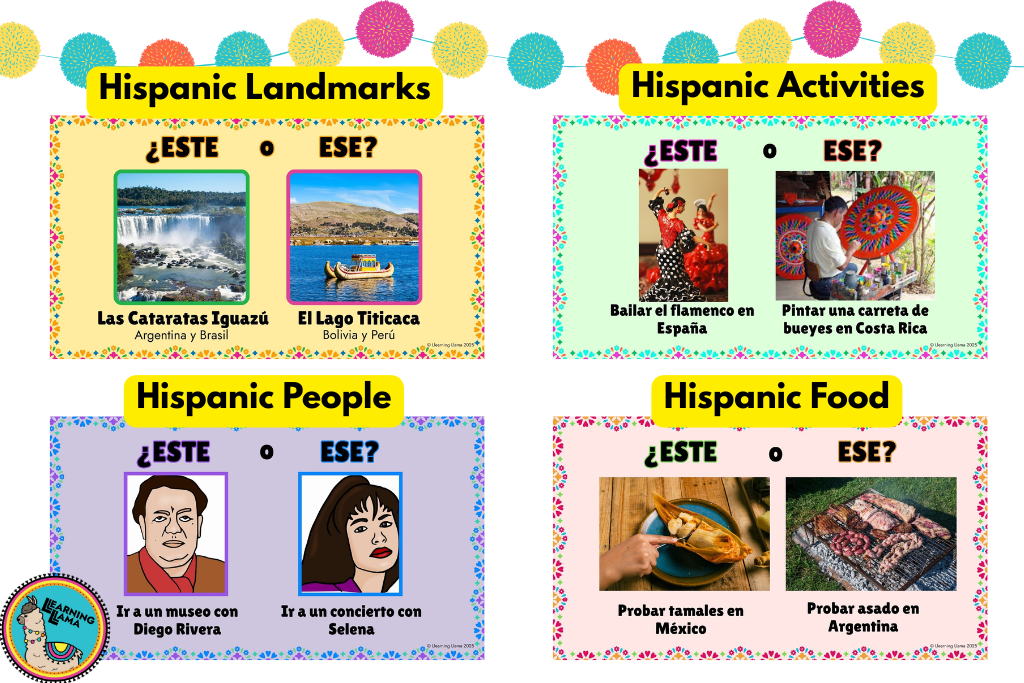
Spanish 1: Use Would You Rather questions with cognates and images: ¿chocolate o vainilla? ¿parque o océano?
Spanish 2: Increase the level of Would You Rather questions with words that they learned in Spanish 1. Use images and simple phrases.
Spanish 3+: Use Hispanic culture Would You Rather cards to keep the theme of Hispanic culture (tied to La Tomatina).
You can get my set of differentiated Would You Rather questions in Spanish or English here.
You can get my set of Hispanic Culture Would You Rather questions here.
Learn more about La Tomatina and 7 Activities to Bring La Tomatina to Life HERE.
Get 15 New Ways to Play Would You Rather HERE.
Day 2: Take a FUN Personality Quiz
Everybody loves taking a personality quiz to find out which color they are… which Friends character they are most similar to… which animal they are, etc. Not only is this an easy way to get to know your students, but they will feel super invested in the quiz because they are eager to see the results. Plus, this eliminates those heart-racing icebreaker games that no one really enjoys. You still get to know your students and they will actually feel comfortable sharing!
You can choose any personality quiz you think your students would most enjoy. If you want to tie it back into Hispanic culture, maybe choose one like “Which famous Hispanic are you?” or “Which alebrije are you?” or “Which of the 7 Hispanic Wonders Should You Travel To?”
Students take a 10-question personality quiz, keeping a tally of their results. Then, they determine which of the 6 results they are!

- Choose the personality quiz you want to assign. Print it out for each student. Print out a handful of each of the 6 results worksheets.
- Take the quiz together as a class, going question by question. Explain anything that students do not understand.
- Have your students add up their responses.
- Give each student a few minutes to read their results.
- Group students by results. They can answer discussion questions and create a quick presentation.
Spanish 1: Provide the English version of one of the Hispanic culture quizzes. With zero knowledge of Spanish, it is okay to start with some culture and fun to get them comfortable!
Spanish 2+: My personality quizzes are for novice high and above.Try any quiz in Spanish! I first began creating these for my 6th grade Spanish classes who took a few years of Spanish in elementary school, so your Spanish 2 students should be able to comprehend these. And if you’re still not sure, try the English version.
Look through all 12 personality quizzes that I have created here.
Learn step-by-step ways to use these personality quizzes during your personality unit here.

Day 3: Common Class Expressions and Expectations
At some point in the first week in Spanish class, you do need to get down to business. But you don’t want to do that on Day 1… that is what most other classes are doing. Yours would get lumped in with all the boring syllabus and expectations talk. Imagine hearing that speech 8 times in one day!? So, save yours for Day 3 (but still add some fun, of course!)
- Introduce common classroom expressions (Tengo una pregunta. ¿Puedo ir al baño?)
- Play games with common classroom expressions. (Matamoscas, Kahoot, matching, etc.)
- Share your syllabus and focus on the content students CAN DO by the end of the year. You can even start with the Can Do Statements for the first unit and have students check off what they currently can do. Hint, hint – it should be NOTHING. But explain what they will be able to do when you check in a few times throughout the unit!
- Go over your class expectations. Again, you can make this fun by making it interactive. Do not just spew off a list of rules. Get students involved. Try this set of Spanish classroom expectations activities.

Spanish 1: Definitely focus on classroom expressions. Have posters displayed around your room and show students where they are.
Spanish 2: They will need a refresher on classroom expressions. You don’t need to spend much time on it.
Spanish 3+: You can skip classroom expressions. They should already be pros at this. Move right into the syllabus and can-do statements.
Day 4: How Do Students Around the World Get to School?
At this point of the first week in Spanish classt, you may be ready to jump into your curriculum. But if you want to add some culture and keep the first week light, try this comprehensible input lesson.
Students in countries around the world have some very interesting, unique, and even dangerous routes to school that make a school bus seem like a fancy limousine! Share about these routes to school with storytelling, analyzing with your 5 senses, listening tasks, and finally presentational writing.
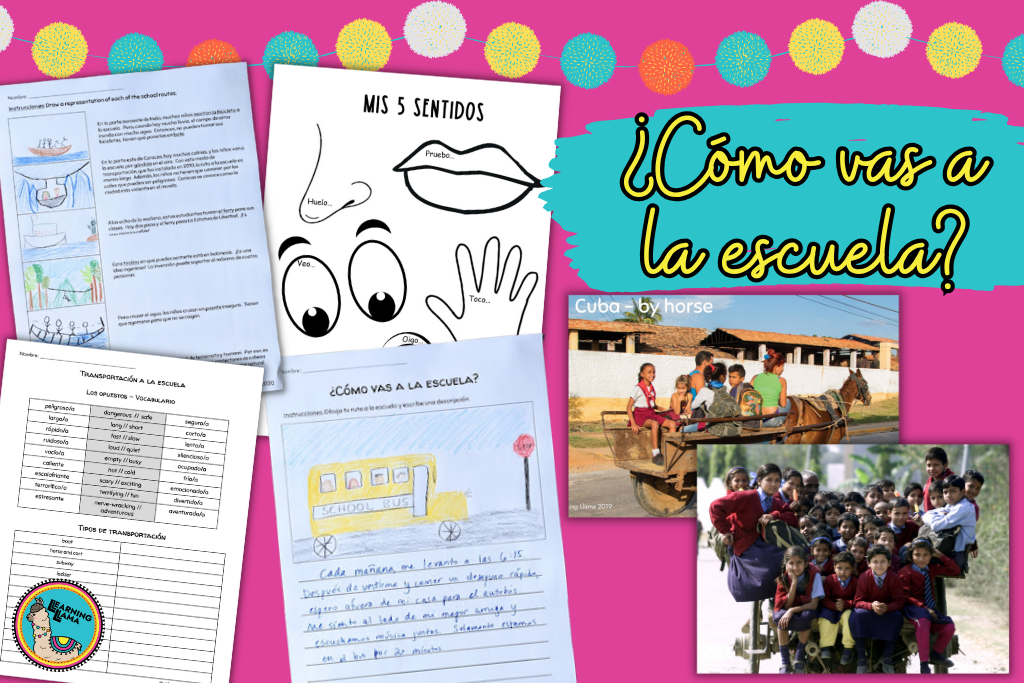
- Start by asking students how they go to school. Draw, write, speak – whatever your students can do.
- Then, share pictures from around the world and use CI to describe these pictures. I have a teacher script in my lesson.
- Analyze the routes, placing yourself right there on the horse-drawn cart or in the boat. Use your 5 senses.
- Draw images to represent what you read or hear.
- Finally, students draw and write about their own route to school.
Spanish 1: You can use English for a cultural lesson during the first week. Or throw in some cognates.
Spanish 2+: Use Spanish with differentiated language and aides. Upper levels can even watch some videos in the target language.
Read my detailed lesson plan for this lesson here.
Grab the resource (Eng & Spa) here.
Day 5: After Break / ABCs
Now here is where you start to really differentiate your lessons by which level you teach.
Spanish 1: The Hispanic ABCs
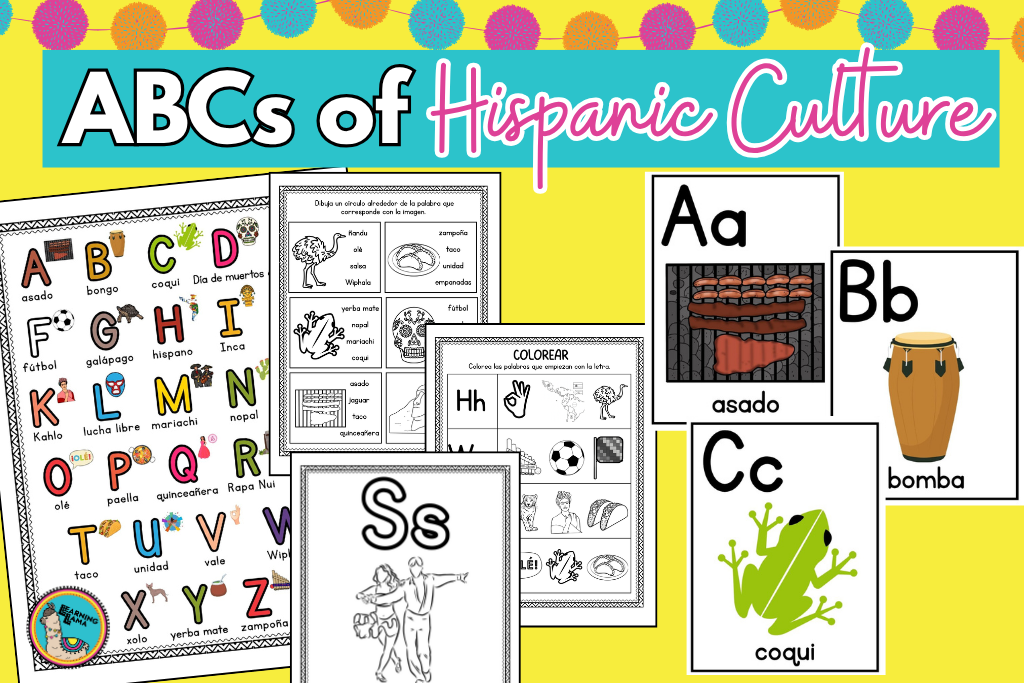
Introduce the ABCs to your students in a new and cultural way. With this set of ABCs, a is for asado, b is for bomba, and all the way to z is for zampoña. Display the cards around your classroom, work on how to pronounce the letters and sounds. There are even flashcards and over 50 worksheets included!
Spanish 2+: What did you do over summer break?
Write about what you did over summer break. Students will need some vocabulary and/or sentence starters since they probably haven’t used Spanish in a few months.
Spanish 2: Comic Strip
Since your Spanish 2 students do not know past tense yet, you will provide 3-5 sentence starters with images to help them understand what they mean. Yo fui a (with a picture of a car or airplane). Yo comí (with a picture of food). Jugué (with a picture of balls). Yo visité (with a picture of a passport). Students can draw pictures and write super simple sentences to match each image. Encourage them to use each of the sentence starters.
Spanish 3+: Comic Strip or Story
These students should know some past tense. They may need a refresher with the sentence starters, but now they can write lengthier descriptions, even with details. Provide them with comic strip templates or story writing templates.

Get the Hispanic ABCs posters, flashcards, and worksheets here.
Get the After Summer break writing templates and vocabulary worksheets here.
Whether it’s your students’ very first day in Spanish or they’re returning for another year, these lesson plans will help you kick things off with confidence and connection. With ready-to-use ideas for both Spanish 1 and upper-level classes, you’ll build a positive classroom culture from day one. Start the year with intention, energy, and activities your students will actually look forward to—because your first day in Spanish should be as memorable as it is meaningful!